This launch comes at a time when militaries worldwide are grappling with the increasing use of First-Person-View (FPV) drones and coordinated swarm attacks—threats capable of paralyzing traditional air defence systems.
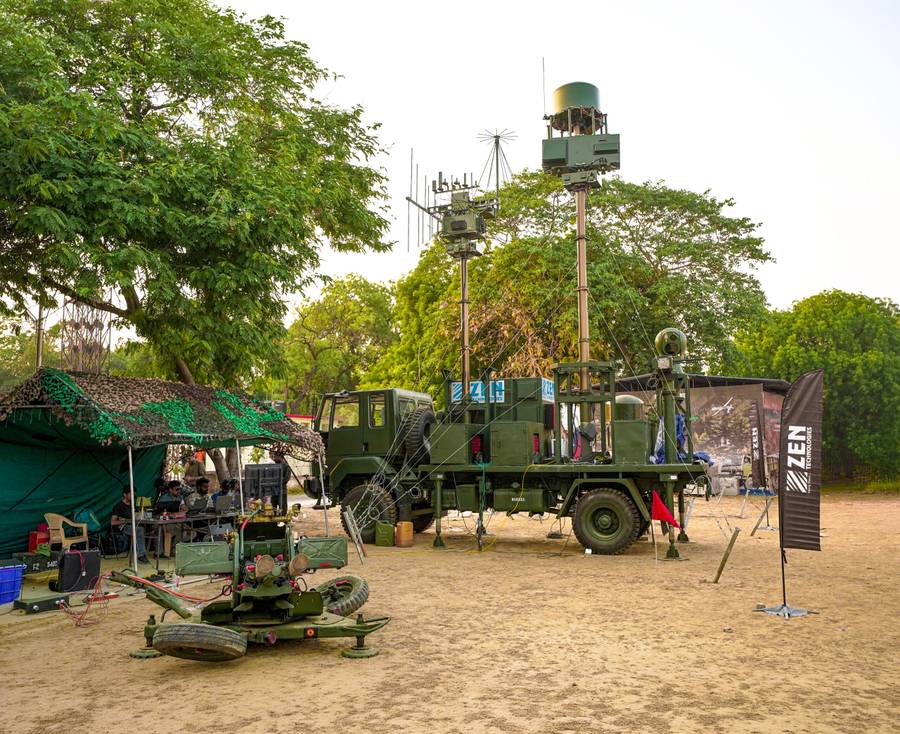
According to the company, this platform integrates both “soft kill” and “hard kill” options within its architectural framework. The system is capable of detecting and disrupting drone communications across a wide frequency band, while also providing kinetic interception capabilities through the integration of weaponry.
At the core of this system lies an Artificial Intelligence (AI) fusion and command center, which synthesizes inputs from multiple sensors to classify, track, and respond to aerial threats in real-time. The company has claimed that this system can detect drones located at a distance of over 15 km and simultaneously track more than 100 targets, making it suitable for countering swarm attacks.
This platform also features a high-sensitivity, indigenously developed radar with a detection range of up to 20 km, designed to identify small drones—particularly those with a low radar cross-section—at a very early stage.
To neutralize drones, the system employs a layered approach that includes Radio Frequency (RF) jamming, GNSS disruption and spoofing, and integration with remote-controlled weapon stations utilizing 12.7 mm and 7.62 mm guns. For “hard-kill” operations, it can also be integrated with air defense guns and loitering interceptors.
Ashok Atluri, Chairman and Managing Director of Zen Technologies, stated that recent conflicts have underscored the changing nature of warfare. He remarked, “Drones are redefining the battlefield, and the real advantage will lie with those who can effectively neutralize these threats.” He added that this system was developed under the government’s indigenization drive, with full intellectual property ownership.