In keeping with tradition, the President of Nepal conferred the honorary rank of General of the Nepalese Army upon General Seth, yet there was no mention of official discussions regarding the resumption of Nepalese citizens’ recruitment into the Indian Army. General Dhiraj Seth is visiting Nepal from August 17 to 19.
This marks the first visit by the Indian Army Chief since the formation of the new government in Nepal—led by 37-year-old Balen Shah—following the ‘Gen Z’ movement. However, right at the inception of the Indian Army’s Agnipath scheme, Nepal had announced that it would not approve the recruitment of its citizens as ‘Agniveers’. Notably, apart from India and the UK, Nepalese citizens cannot enlist in the armed forces of any other country.
While the Indian Army’s Gorkha Regiments are largely composed of personnel of Nepalese origin, recruitment has been halted for years. Army recruitment was suspended following the COVID-19 pandemic caused by the coronavirus outbreak in 2019. Subsequently, after India launched the Agnipath scheme in 2022, Nepal halted the recruitment of its youth. Under this scheme, up to 25 percent of recruits are retained for permanent service after a four-year tenure. The remaining 75 percent are discharged from army service with a lump-sum payment and do not receive pensions or other long-term career benefits.
The Government of Nepal had halted the recruitment of Nepali youth into the Indian Army, arguing that the scheme did not align with the provisions of the 1947 Tripartite Agreement between India, Nepal, and Britain.
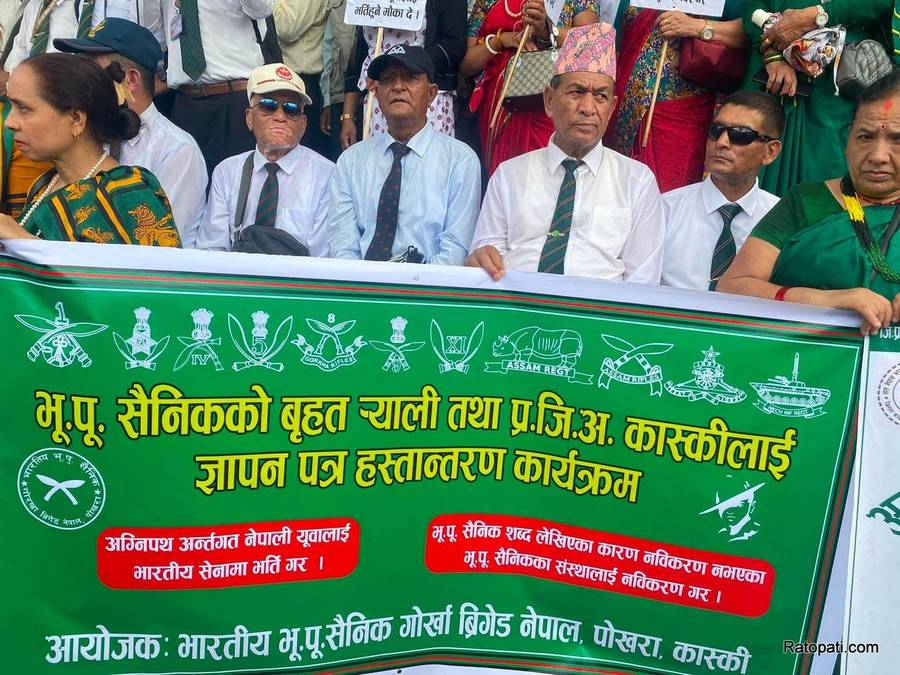
However, due to limited employment opportunities in Nepal, many young people are still interested in joining the Indian Army under the Agnipath scheme. At a rally in Pokhara, demands were made for the government to reconsider its stance and allow Nepali youth to join the Indian Army under the Agnipath recruitment scheme.
Ex-servicemen, their family members, and youths who had trained to join foreign armies participated in this protest organized by the ‘Indian Ex-Servicemen Gorkha Brigade Nepal’. Protesters carried placards demanding the resumption of recruitment of Nepali youth under the Agnipath scheme. They argued that instead of being forced to seek employment in Gulf countries, Nepali youth should be permitted to join the Indian Army as ‘Agniveers’.
Key demands shared on social media included the immediate resumption of the Agnipath recruitment process. They stated that this was essential to safeguard employment opportunities for Nepali youth and to preserve the identity and traditions associated with Gurkha soldiers.
The protesters also demanded that the registration process for organizations representing ex-servicemen—and using the term “ex-servicemen”—should not be obstructed. They maintained that such organizations are vital for protecting the dignity, rights, and interests of ex-servicemen. The organizers termed the event a ‘Peace March’. Participants marched from Pokhara Stadium to the Kaski Chief District Officer’s office, located at the District Administration Office complex, and submitted a memorandum.