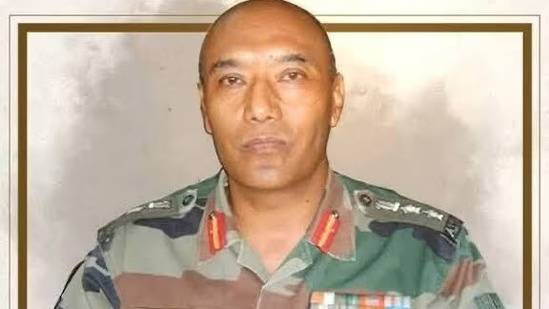
This news comes as a shock to all those who knew the retired Colonel Sonam Wangchuk—popularly known as the ‘Lion of Ladakh.’ Although he was 61 years old, he remained in excellent health until very recently. On Thursday night, while at home in Leh (Ladakh), he went to sleep—and never woke up. A revered war hero known for his extraordinary bravery during the Kargil War, he leaves behind a magnificent legacy of courage and service to the nation.
Recipient of the prestigious ‘Maha Vir Chakra,’ Sonam Wangchuk held the rank of Major during the Kargil War. On May 30, 1999—leading soldiers of the ‘Ladakh Scouts’ across the treacherous and snow-clad heights of ‘Chorbat La’ without any artillery support—he executed an operation that marked one of the Indian Army’s initial victories against the enemy Pakistani forces. This triumph laid a strong foundation for subsequent military operations.
Colonel Sonam Wangchuk‘s brother-in-law, Dr. Sonam Angchuk, told the media persons that the Colonel had been complaining of chest pain and discomfort over the past few days. His father had passed away earlier this year, in January. Therefore, he had arrived here (in Leh, Ladakh) to participate in the prayers and other rituals being held for the peace of his father’s soul. Dr. Sonam believes that since numerous relatives and friends were visiting him to offer their condolences, he may have been under some mental stress.
Dr. Sonam Angchuk further explained, “For the past few days, he had been complaining of chest pain. Yesterday, around 2:30 PM, I took him to the Army Hospital, where he underwent an ECG, an ultrasound, and several other necessary tests. The results of all the examinations came back normal. He was feeling fine himself. We returned home, and his echocardiogram (heart examination) was scheduled for today. Yesterday evening, I administered some muscle relaxants to him, and we subsequently went to sleep. Early this morning, the individual who went to his room to serve him warm water or tea found that the Colonel was unresponsive. He immediately alerted everyone. We all rushed to Sonam’s room and discovered that he had passed away.”
Dr. Angchuk mentioned that Wangchuk‘s wife, Padma Angmo, is a civil servant belonging to the Union Territory cadre and is currently posted in Delhi. The couple’s son, Rigyal Ovum, is an IIM graduate and works in Bengaluru. Wangchuk‘s mother resides in Leh.
Speaking about the funeral arrangements, Dr. Angchuk noted that in Buddhism, monks arrive to perform the necessary rituals; only after these rites are completed is the date for the funeral ceremony decided.
Born in January 1964 to Sonam Wangyal, Wangchuk completed his schooling at the renowned Modern School in New Delhi. Wangchuk, who had been deeply passionate about sports since childhood, participated in cross-country marathons before deciding to pursue a career in the Army. To join the Army, he left his undergraduate studies at Sri Venkateswara College, Delhi University, midway and was commissioned into the Assam Regiment on September 4, 1987. Later, he was posted to the Ladakh Scouts—a unit famously known as the ‘Snow Warriors.’The Ladakh Scouts played a pivotal role in the Kargil War. for their exemplary performance, they were honored with a ‘Unit Citation’ by the then Army Chief, V.P. Malik.The Kargil War, which took place in 1999, effectively began in the aftermath of the Lahore Declaration, when the Pakistani Army seized control of strategically vital peaks near the Line of Control (LoC). Tensions escalated following the detection of infiltration on May 3rd, prompting a coordinated military response from the Indian side. This response included airstrikes by the Indian Air Force and the launch of ‘Operation Vijay’ by the Indian Army. After fierce fighting, the conflict concluded on July 26, 1999.One of the most critical sectors during the war was ‘Chorbat La,’ situated in the Batalik sub-sector at an altitude of 18,000 feet. This region held immense strategic significance due to its proximity to National Highway 1A and its historical use as an infiltration route.
Wangchuk was tasked with securing Chorbat La and establishing an observation post there amidst extremely adverse weather conditions. Demonstrating exceptional leadership, he led a small team across deep, snow-laden trails and through treacherous, inaccessible terrain. On May 30, 1999, he engaged in a confrontation with enemy soldiers, during which he killed two of them and forced the others to retreat.
Subsequently, despite heavy artillery fire and the threat of an imminent attack, he reinforced another observation post. After several hours of fierce fighting, Wangchuk launched an assault on an enemy-held post and successfully captured it. These post were named after him ‘Sonam1’ and ‘Sonam 2 ‘.